 Tronhood
 Captains Diary
Tronhood
Tronhood Captains Diary
Ein Testtag zwischen Genie und Speicherwarnung
Lokale LLMs auf einem M4 mit 16 GB: Ein Testtag zwischen Genie und Speicherwarnung
Datum: 2026-04-24
Autor: Testteam (aka: wir, Kaffee und Activity Monitor)
DEUTSCH
Warum dieser Test überhaupt?
Weil Benchmarks in schönen Diagrammen nett sind, aber im echten Leben nicht beantworten, was man wirklich wissen will:
- Läuft das Modell stabil auf echter Alltags-Hardware?
- Antwortet es zuverlässig auf Business-Aufgaben?
- Ist es nur schnell oder auch brauchbar?
- Und ganz wichtig: Muss jemand den ganzen Tag daneben sitzen und manuell Tabellen pflegen?
Wir haben also nicht „schau mal, wie viele Tokens pro Sekunde“ getestet, sondern „kann ich damit in der Praxis arbeiten, ohne jeden zweiten Run zu verfluchen“.
Das Setup: Mac mini M4, 16 GB RAM, Realität statt Rechenzentrum
Unser Testsystem war bewusst kein Monster-Server, sondern ein praxisnahes Setup:
- Gerät: Mac mini (M4)
- RAM: 16 GB
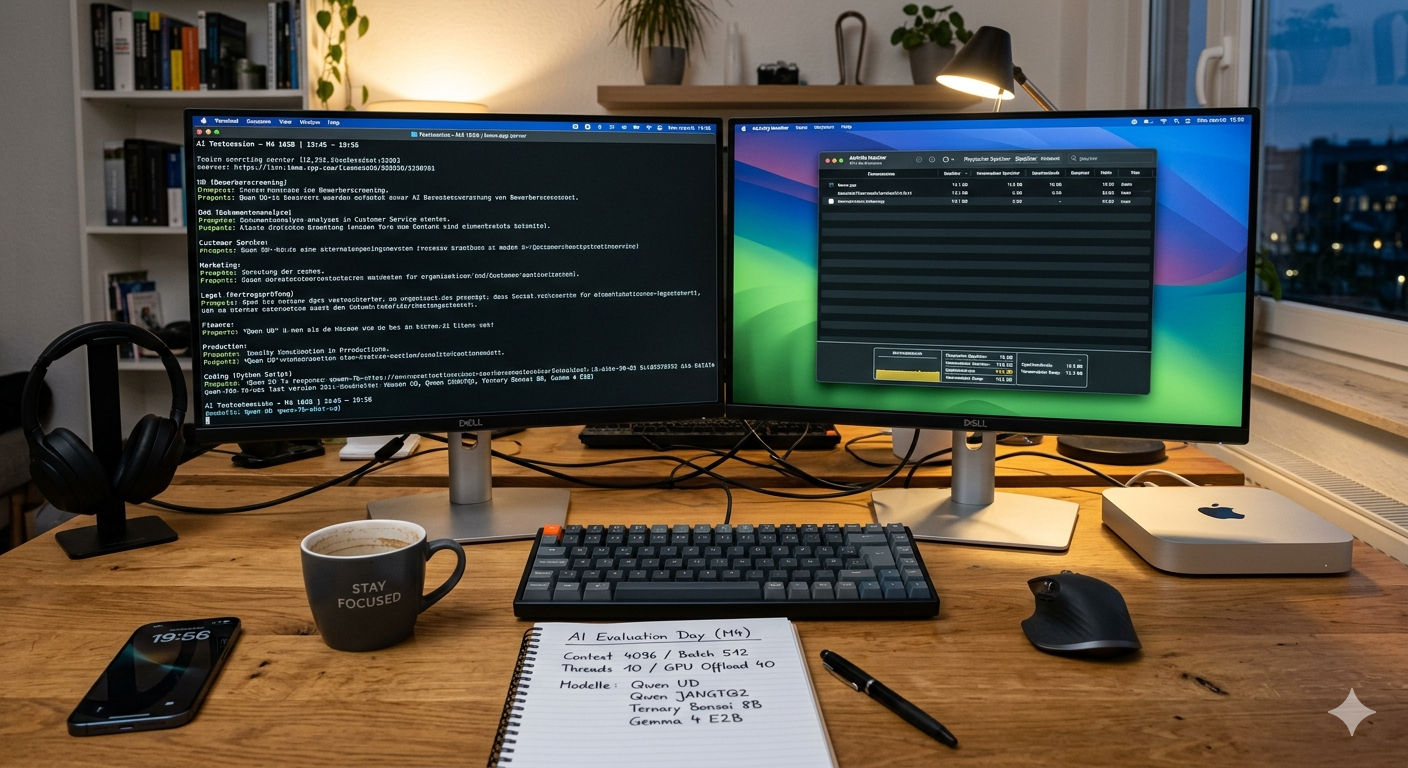
- Tooling: LM Studio + dokumentierte Screenshots + strukturierte Score-Dateien
- Bewertungslogik pro Run:
- Accuracy/Faithfulness (0–5)
- Format/Compliance (0–5)
- Robustness (0–5)
- Practicality (0–5)
- plus Pass/Fail, Latenz, Output-Tokens, Tokens/s
Die 4 Modellkonfigurationen im Test
Getestet wurden:
qwen3.6-35b-a3b-ud(stark komprimiert, UD/Unsloth)qwen3.6-35b-a3b-jangtq2(stark komprimiert, JANGTQ2)ternary-bonsai-8b-mlxgoogle/gemma-4-e2b
Wichtig: Die zwei Qwen-Varianten wurden teilweise unter demselben Modellnamen in Logs geführt, daher erfolgte die Auswertung in einer gemeinsamen Hauptsequenz plus expliziter Erwähnung beider Varianten.
Die 8 Testfelder (immer gleich, für alle Modelle)
Damit der Vergleich fair bleibt, mussten alle Modelle dieselben Aufgaben lösen:
MIX-HR-001– HR-Faktencheck + Absage + ComplianceRAG-001– Long-Context-Recall (Eskalationsregel E-17)CS-001– Kundenservice-Deeskalation + valides JSONMKT-002– Marketing-Slogans + LinkedIn + KrisenantwortLEG-001– DSGVO-Risiko + Klausel + GrenzfallFIN-001– Zahlenanalyse + Executive Summary + Python-FunktionPROD-001– Sicherheitsurteil + technisches JSON + Shutdown-ProzessCODE-002– SQL-Injection-Fix + FastAPI + Passwort-Hashing-Best-Practice
Der eigentliche Bossfight: Qwen laden auf 16 GB
Der wichtigste Praxispunkt des ganzen Tages:
Die Qwen-Modelle waren im Normalzustand nicht stabil ladbar. Nicht „ein bisschen langsam“, sondern „LM Studio sagt nein“.
Beobachtet wurde bei hohen Default-Settings sinngemäß:
Not enough resources to load the model with the current settings.
Stabil wurde es erst nach gezieltem Tuning. Das funktionierende Profil sah so aus:
- Context Length:
~4096(statt sehr hoch) - GPU Offload:
40 - CPU Thread Pool:
10 - Evaluation Batch Size:
512 - Unified KV Cache: aktiv
- Offload KV Cache to GPU Memory: aktiv
- Keep Model in Memory: aktiv
- Try mmap(): aktiv
- Flash Attention: aktiv
Kurz: Das Modell war nicht „kaputt“, aber ohne Runtime-Disziplin nicht praxistauglich auf dieser Hardware.
Was lief gut, was tat weh?
Qwen (UD/JANGTQ2)
Stärken:
- inhaltlich oft sehr stark
- gute Antworten in HR, RAG, Marketing, Legal, Production
Schwächen:
- klar settings-sensitiv
- unter Last spürbarer Memory-/Swap-Druck
- in der Coding-Sequenz einmal Context-Limit-bedingter Output-Cut
Qwen war damit wie ein sehr talentierter Kollege, der hervorragende Arbeit macht, aber nur wenn der Schreibtisch exakt richtig eingestellt ist.
Ternary Bonsai 8B MLX
Stärken:
- schnell, klar, stabil
- in mehreren Bereichen sehr präzise
- im Alltag überraschend stark konkurrenzfähig
Einziger nennenswerter Abzug:
FIN-001war vollständig, aber die Ziel-Abweichungslogik wurde uneinheitlich dargestellt (inhaltlich brauchbar, methodisch nicht perfekt).
Ternary war der Kandidat, der ohne großes Drama liefert und dabei konstant wirkt.
Gemma 4 E2B
Stärken:
- insgesamt beste Balance aus Qualität, Stabilität und Geschwindigkeit
- sehr robuste Antworten in fast allen Feldern
- besonders stark im Coding/Security-Paket
Abzug:
- in
PROD-001wurden im JSON die Grenzwerte nicht sauber auf die Sollwerte gesetzt (inhaltliche Sicherheitslogik war aber korrekt).
Gemma war an dem Tag der „ich mache einfach meinen Job“-Performer.
Der versteckte Produktivitätskiller: Erfassungsworkflow
Die größte Bremse war nicht die Modellqualität, sondern die Begleitdokumentation:
- Rohdaten waren da (Screenshots, Antworten)
- aber nicht jeder Run wurde sofort konsistent in strukturierte Tabellen übernommen
- dadurch stieg der manuelle Nachpflegeaufwand massiv
Das ist der Kern-Learning-Punkt: Nicht nur LLMs benchmarken, sondern den Erfassungsprozess genauso ernst nehmen wie die Antworten.
Unsere Zeitbilanz (heute)
- Erster Screenshot:
13:45:16 - Letzter Screenshot:
19:56:21 - Brutto-Zeitfenster: 6h 11m 05s
- Netto-Aktivzeit (je nach Pausenfilter): grob 3.5h+ aktive Testarbeit
Anders gesagt: Ja, wir haben viel gelernt. Ja, es war aufwändig. Und ja, der Activity Monitor hatte heute auch einen vollen Arbeitstag.
Sternchenbewertung (Antwortqualität gesamt)
google/gemma-4-e2b:*****(4.88/5)ternary-bonsai-8b-mlx:*****(4.75/5)qwen3.6-35b-a3b(UD/JANGTQ2 zusammen):****-(4.28/5)
Zusammenfassung und Fazit (DE)
Wenn wir nur nach „gefühlter Alltagstauglichkeit“ entscheiden:
- Gemma 4 E2B ist aktuell die beste Primärwahl.
- Ternary Bonsai 8B MLX ist ein sehr starker Zweitkandidat und muss sich nicht verstecken.
- Qwen (UD/JANGTQ2) bleibt qualitativ stark, braucht aber diszipliniertes Runtime-Tuning auf 16-GB-Hardware.
Das wichtigste Meta-Fazit: Der nächste große Gewinn kommt nicht nur von besseren Modellen, sondern von einem modularen, automatisierten Test- und Reporting-Flow.
ENGLISH
Why we ran this test in the first place
Because pretty benchmark charts rarely answer the painful real-world questions:
- Does the model run reliably on normal hardware?
- Is the output business-usable, not just verbose?
- Is it fast and accurate, or just fast and confident?
- And the big one: can you test at scale without babysitting logs all day?
So this was a practical stress test, not a vanity metric exercise.
The setup: Mac mini M4, 16 GB RAM, real constraints
We intentionally used a constrained but realistic machine:
- Device: Mac mini (M4)
- RAM: 16 GB
- Stack: LM Studio + screenshot evidence + structured scoring sheets
- Scoring dimensions per run:
- Accuracy/Faithfulness (0–5)
- Format/Compliance (0–5)
- Robustness (0–5)
- Practicality (0–5)
- plus Pass/Fail, latency, output tokens, tokens/s
The 4 model configurations
qwen3.6-35b-a3b-udqwen3.6-35b-a3b-jangtq2ternary-bonsai-8b-mlxgoogle/gemma-4-e2b
Important: the two Qwen variants were partly logged under overlapping names, so we evaluated them as one main sequence with explicit variant notes.
The 8 test domains (identical for each model)
MIX-HR-001– HR fact-check + rejection email + complianceRAG-001– long-context recall (E-17 escalation rule)CS-001– customer de-escalation + valid JSONMKT-002– slogans + LinkedIn post + public crisis responseLEG-001– GDPR risk + legal clause + edge-case handlingFIN-001– analytics + executive summary + Python functionPROD-001– safety decision + technical JSON + shutdown processCODE-002– SQL injection fix + FastAPI endpoint + password hashing best practice
The real boss level: loading Qwen on 16 GB
This was the key operational finding:
Qwen did not run reliably on default settings. We hit LM Studio resource errors at high context settings.
The stable profile required tuning:
- Context length:
~4096 - GPU offload:
40 - CPU threads:
10 - Eval batch:
512 - Unified KV cache: enabled
- Offload KV cache to GPU memory: enabled
- Keep model in memory: enabled
- Try mmap(): enabled
- Flash attention: enabled
In short: strong model, but only with disciplined runtime configuration on this hardware.
What worked and what hurt
Qwen (UD/JANGTQ2)
Pros:
- often excellent content quality
- strong performance across multiple business tasks
Cons:
- highly sensitive to memory/runtime settings
- visible swap pressure under load
- one coding run suffered from context-length clipping
Ternary Bonsai 8B MLX
Pros:
- very fast and responsive
- consistently strong, practical answers
- surprisingly competitive overall
Main deduction:
FIN-001had complete output but inconsistent target-deviation logic.
Gemma 4 E2B
Pros:
- best overall balance (quality + speed + stability)
- robust across almost all domains
- especially strong in coding/security tasks
Deduction:
PROD-001JSON values were not populated with the expected max spec values (while safety reasoning itself was correct).
The hidden bottleneck: capture workflow
The biggest pain point was not model intelligence. It was process friction:
- raw evidence existed,
- but normalization into structured scoring files was not always immediate,
- which increased manual cleanup effort dramatically.
Lesson learned: your evaluation pipeline is part of your benchmark.
Time spent (today)
- First screenshot:
13:45:16 - Last screenshot:
19:56:21 - Gross window: 6h 11m 05s
- Active test effort: roughly 3.5h+ depending on break filtering
Yes, the models were tested. Also yes, the humans were tested.
Star rating (overall answer quality)
google/gemma-4-e2b:*****(4.88/5)ternary-bonsai-8b-mlx:*****(4.75/5)qwen3.6-35b-a3b(UD/JANGTQ2 combined):****-(4.28/5)
Summary and final verdict (EN)
If we optimize for practical pilot readiness:
- Gemma 4 E2B is the top primary candidate.
- Ternary Bonsai 8B MLX is a very strong second option.
- Qwen (UD/JANGTQ2) remains high-quality but requires strict runtime tuning on 16 GB hardware.
Big-picture conclusion: The next major improvement will come from a modular capture-scoring-reporting pipeline, not only from switching to newer models.
SRPSKI
Zašto smo radili ovaj test?
Zato što lepi benchmark grafikoni ne odgovaraju na najvažnija praktična pitanja:
- Da li model stabilno radi na realnom hardveru?
- Da li su odgovori upotrebljivi za posao?
- Da li je samo brz ili i tačan?
- I najvažnije: da li test može da se vodi bez celodnevnog ručnog praćenja?
Dakle, cilj je bio praksa, ne samo brojke.
Setup: Mac mini M4, 16 GB RAM, realna ograničenja
Koristili smo namerno realno ograničen sistem:
- Uređaj: Mac mini (M4)
- RAM: 16 GB
- Alati: LM Studio + screenshot evidencija + strukturisane score tabele
- Ocenjivanje po run-u:
- Accuracy/Faithfulness (0–5)
- Format/Compliance (0–5)
- Robustness (0–5)
- Practicality (0–5)
- plus Pass/Fail, latency, output tokens, tokens/s
Korišćene 4 konfiguracije modela
qwen3.6-35b-a3b-udqwen3.6-35b-a3b-jangtq2ternary-bonsai-8b-mlxgoogle/gemma-4-e2b
Napomena: dve Qwen varijante su delom vođene pod sličnim nazivima, pa su u glavnoj sekvenci posmatrane zajedno uz jasne napomene.
Osam test-polja (isto za sve modele)
MIX-HR-001– HR provera činjenica + odbijenica + complianceRAG-001– long-context recall (E-17 pravilo eskalacije)CS-001– deeskalacija korisnika + validan JSONMKT-002– slogani + LinkedIn + javni krizni odgovorLEG-001– GDPR rizik + klauzula + granični slučajFIN-001– analitika + executive summary + Python funkcijaPROD-001– safety odluka + tehnički JSON + shutdown proceduraCODE-002– SQL injection fix + FastAPI + best practice za hash lozinki
Glavni izazov: Qwen na 16 GB
Ključni operativni nalaz:
Qwen nije bio stabilno upotrebljiv na podrazumevanim visokim podešavanjima. Dobijali smo greške zbog resursa.
Stabilan profil je zahtevao tuning:
- Context:
~4096 - GPU offload:
40 - CPU threads:
10 - Eval batch:
512 - Unified KV cache: uključen
- Offload KV cache to GPU memory: uključen
- Keep model in memory: uključen
- Try mmap(): uključen
- Flash attention: uključen
Ukratko: odličan potencijal, ali traži disciplinovano runtime podešavanje.
Šta je bilo dobro, a šta nas je kočilo?
Qwen (UD/JANGTQ2)
Prednosti:
- često vrlo kvalitetan sadržaj
- jaki rezultati kroz više poslovnih scenarija
Slabosti:
- osetljivost na podešavanja i memorijski budžet
- vidljiv swap pritisak pod opterećenjem
- jedan coding run presečen zbog context limita
Ternary Bonsai 8B MLX
Prednosti:
- veoma brz i responzivan
- stabilni, praktični odgovori
- vrlo konkurentan u ukupnom zbiru
Glavni minus:
FIN-001je kompletan, ali logika odstupanja od cilja nije potpuno dosledna.
Gemma 4 E2B
Prednosti:
- najbolji ukupni balans kvaliteta, brzine i stabilnosti
- robustan kroz skoro sve test-polja
- posebno jak u coding/security delu
Minus:
- u
PROD-001JSON vrednosti nisu ubačene po očekivanim max specifikacijama (iako je safety zaključak bio dobar).
Skriveni problem: workflow beleženja
Najveći problem nije bio kvalitet modela, već proces:
- sirova evidencija je postojala,
- ali normalizacija u strukturisane tabele nije uvek bila trenutna,
- što je povećalo ručni rad.
Pouka: pipeline za evidenciju je jednako važan kao i sam model.
Vreme (danas)
- Prvi screenshot:
13:45:16 - Poslednji screenshot:
19:56:21 - Bruto prozor: 6h 11m 05s
- Aktivni deo rada: približno 3.5h+ (zavisno od filtera pauza)
Drugim rečima: testirali smo modele, ali i sopstveno strpljenje.
Zvezdana ocena (ukupan kvalitet odgovora)
google/gemma-4-e2b:*****(4.88/5)ternary-bonsai-8b-mlx:*****(4.75/5)qwen3.6-35b-a3b(UD/JANGTQ2 zajedno):****-(4.28/5)
Sažetak i zaključak (SR)
Ako gledamo praktičnu spremnost za pilot:
- Gemma 4 E2B je prvi izbor.
- Ternary Bonsai 8B MLX je vrlo jak drugi kandidat.
- Qwen (UD/JANGTQ2) ostaje kvalitetan, ali traži striktna runtime podešavanja na 16 GB hardveru.
Glavni zaključak: Sledeći veliki napredak neće doći samo od „još boljeg modela“, već od modularnog i automatizovanog capture-scoring-reporting procesa.